Blog
Language
AIM provides industrial heat pump dryers specifically engineered for okra. Our energy-saving systems offer precise low-temperature drying, locking in the okra’s bright green color and essential nutrients. Designed for continuous large-scale production, AIM heat pump dryers reduce operating costs by up to 70% compared to traditional methods. Achieve premium, uniform dried okra with AIM’s intelligent, closed-loop dehydration technology.
📋 Full-process production technology
Standardized industrial processes are the key to ensuring stable product quality.
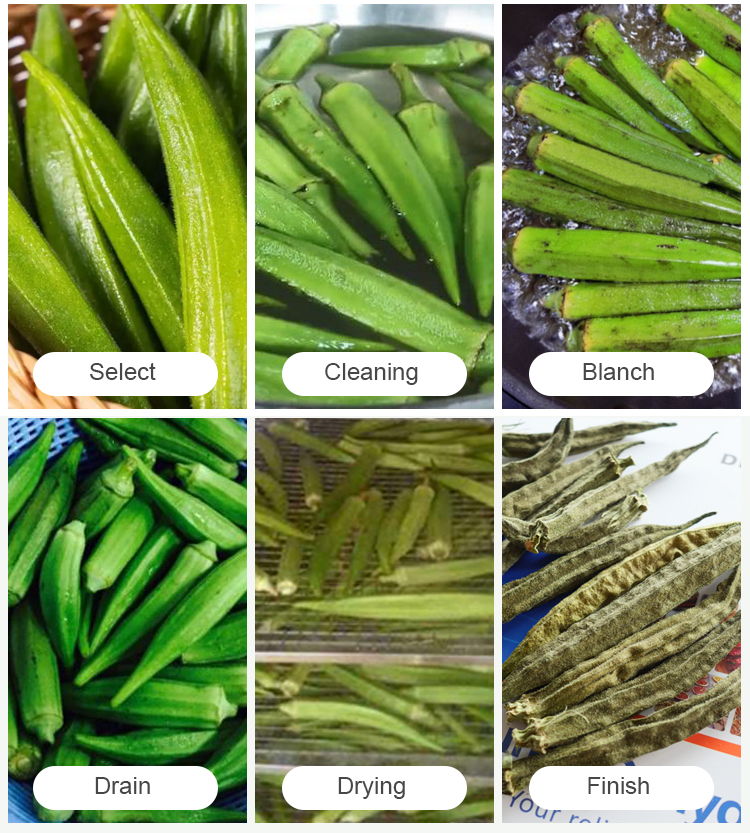
Raw material selection:
Control at the source, eliminate raw materials with pests, diseases, and mechanical damage, and select tender
fruits with a length of 10-15cm. This is the primary prerequisite for obtaining high-quality dried products.
Cleaning and blanching (key pretreatment):
1.Utilizing a professional production line for fruit and vegetable washing and blanching, the processing capacity
can reach 500kg/h to 1500kg/h.
2.The blanching temperature should be controlled at 80-100℃ for 2-10 minutes. This step effectively fixes the color,
sterilizes, and inactivates enzymes, preventing discoloration during the drying process.
Cooling, draining, and placing on trays:
Immediately cool with cold water or ice water after blanching, then drain the surface moisture and evenly spread on
the drying trays.
Entering the room for drying (segmented process):
Industrial production often adopts a segmented drying process, achieving optimal quality through precise control of
temperature and humidity. Below is a reference full-fruit drying process, but it is strongly recommended that all processes
be optimized through small-scale trials based on the variety, maturity, and equipment characteristics of the okra.
| Stage | Core Purpose | Reference Parameters | Key Points |
Stage 1: Low-temperature color fixation | Slowly dehydrate at low temperature to fix the bright green color and prevent the epidermis from turning black | Temperature: 40-50℃ Humidity: about 30% Time: 2-5 hours | This stage is the core link determining the appearance quality, achieved through "low-temperature slow baking" |
Stage 2: Rapid Dehumidification | After the material undergoes deformation, a large amount of free water is quickly discharged to enhance drying efficiency. | Temperature: 50℃ Humidity: reduced to 15% Duration: 5-8 hours | If the humidity fails to decrease as expected, briefly open the dehumidification vent to assist in moisture removal |
Stage 3: Slow Drying | Reduce the drying rate to ensure uniform migration of internal moisture to the surface, preventing "outer dryness and inner wetness" | Temperature: 60℃ Humidity: 10% Duration: 4-6 hours | As we enter the later stage of drying, it is important to avoid surface hardening and patiently wait for the internal moisture to transfer |
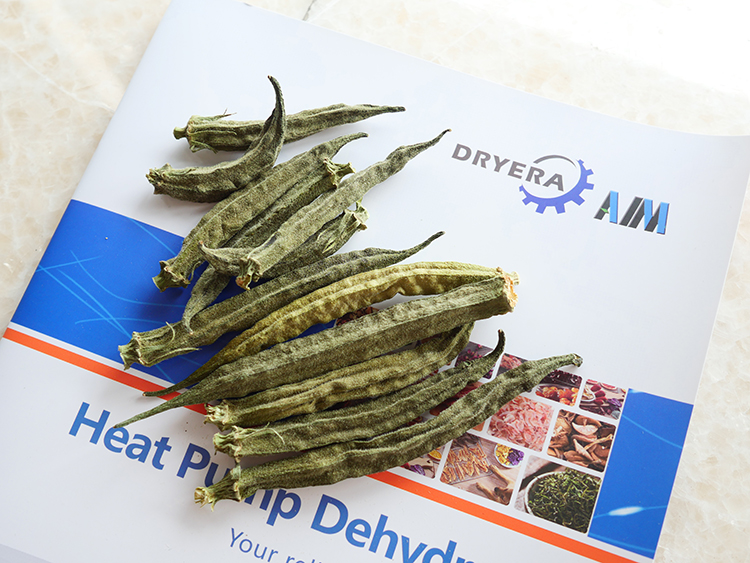
Stage 4: Final drying and consolidation | Further remove bound water to ensure the product meets safe storage moisture standards | Temperature: 65-68℃ Humidity: 10% Duration: 2-3 hours | Upon completion of this stage, the okra should exhibit a light texture and crumble easily when pinched |
💰 Cost and benefit
Direct economic benefits: Heat pump drying significantly enhances the added value of okra. Cases show that the
wholesale price of high-quality okra dried by heat pump can reach around 70 yuan per jin, providing considerable
profit margins for both enterprises and farmers.
Operating cost comparison: Heat pump technology boasts an extremely high Coefficient of Performance (COP),
consuming 1 kWh of electricity to transfer the equivalent of approximately 4 kWh of heat. Compared to traditional
methods, its energy-saving advantage is extremely pronounced:
The operating cost is only about 1/4 of that of traditional electric heating.
It saves about 70% of the operating costs compared to gas, coal, and other methods

 sales@aimheatpump.com
 +0086-18022011556