Blog
Language
Why Choose a Heat Pump Food Dehydrator for Your Prunes?
When it comes to drying fruits like prunes on a commercial scale, a Heat Pump Food Dehydrator offers unmatched advantages over traditional drying methods. Combining large capacity with cutting-edge technology, it is the ideal solution for businesses looking to maximize efficiency while maintaining product quality.
1. Energy Efficiency & Cost Saving
2. Superior Product Quality
3. Eco-Friendly Operation
4. Versatile Large Capacity
5. Consistent 24/7 Performance
From Fresh Prune to Premium Dried Fruit: A Comparative Study of Heat Pump Drying vs. Traditional Sun Drying
Introduction
The transformation of fresh prunes into shelf-stable dried fruit is both an art and a science. For commercial producers, the choice of drying method directly impacts product quality, operational costs, and market competitiveness. This article provides a detailed comparison between modern heat pump food dehydrators and traditional sun drying methods, specifically focusing on the drying of prunes. We'll examine the before-and-after effects on fruit quality, drying efficiency, and overall business value.
Visual Comparison: Fresh Prunes vs. Dried Prunes
The Starting Point: Fresh Prunes
Fresh prunes (fresh plums destined for drying) typically contain 75-85% moisture. At this stage, they are plump, juicy, and highly perishable, with a shelf life of only days. Their skin is taut, color is vibrant (deep purple to blue-black), and flesh is firm yet yielding.
The End Result: Dried Prunes
Quality dried prunes should achieve a final moisture content of approximately 20-25% (wet basis) or 30±1% (dry basis) for optimal preservation and texture-2. They should be chewy but not hard, sweet with concentrated flavor, and have a shelf life of 6-12 months when properly stored.
However, how you get from fresh to dried makes all the difference—and this is where our heat pump technology separates itself from traditional methods.
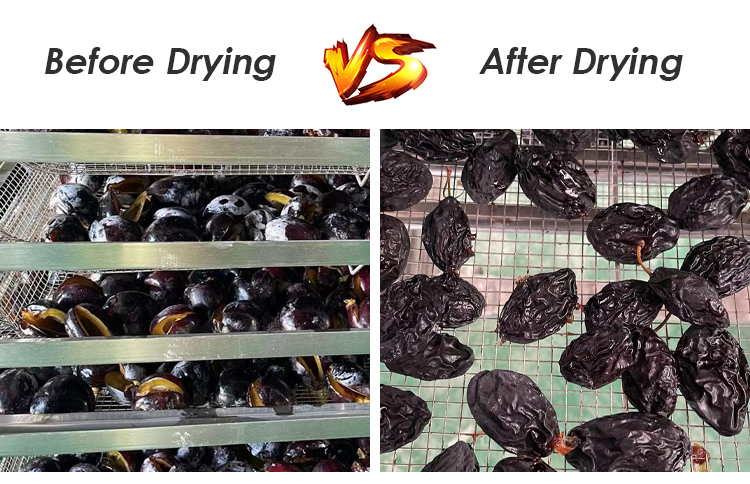
Drying Method Comparison: Before and After Effects
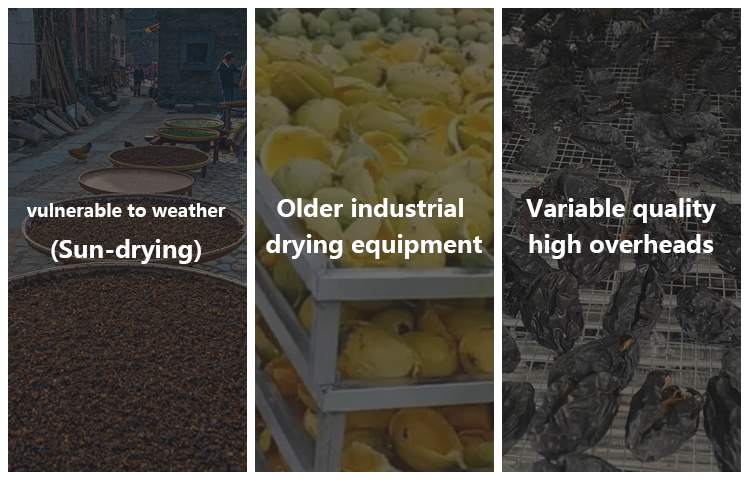
1. Visual Appearance and Color Retention
Traditional Sun Drying:
Before: Fresh prunes with vibrant natural color
After: Prunes often develop uneven darkening; surface may appear dull or cloudy-2
Issues: Prolonged UV exposure degrades pigments; dust and debris accumulate on sticky fruit surfaces-8; color variation between prunes on the same drying bed
Heat Pump Drying:
Before: Fresh prunes with intact color compounds
After: Prunes retain excellent color with no obvious difference in appearance compared to fresh fruit
Advantages: Controlled environment with no UV damage; enclosed drying chamber prevents dust contamination; uniform color across entire batch due to even airflow distribution
2. Texture and Mouthfeel
Traditional Sun Drying:
Before: Firm, juicy flesh with good turgor
After: Research shows sun-dried prunes have the smallest hardness value among all drying methods
Issues: Overly soft texture can indicate structural breakdown; inconsistent drying leads to some prunes being leathery while others remain under-dried; risk of case hardening where the surface hardens while interior remains moist
Heat Pump Drying:
Before: Optimal moisture distribution throughout the fruit
After: Heat pump-dried prunes achieve similar hardness and texture quality to conventional hot air drying
Advantages: Precise temperature control prevents case hardening-7; uniform drying ensures every prune reaches target texture; gentle moisture removal preserves cellular structure
3. Flavor Development
Traditional Sun Drying:
Before: Fresh prune flavor with high acidity and astringency
After: Interestingly, sun-dried prunes show the maximum increase in volatile flavor compounds
However: This flavor development comes at a cost—extended drying time (13.5 hours versus 6 hours for heat pump); exposure to environmental contaminants; inconsistent flavor profile across batches
Heat Pump Drying:
Before: Natural sugars and flavor precursors intact
After: Heat pump-dried prunes achieve flavor quality comparable to hot air drying, with superior preservation of heat-sensitive aromatic compounds
Advantages: Low-temperature drying (typically 30-85°C) preserves volatile compounds; no smoke or fuel odors absorbed by fruit; consistent flavor profile batch after batch
4.Energy Consumption and Cost
Traditional Sun Drying:
Energy cost: Zero direct energy input
Hidden costs: Extensive labor for turning and monitoring; losses from weather damage; reject rates from contamination; large land area requirement; inconsistent quality leading to price discounts
Heat Pump Drying:
Energy efficiency: Consumes 50-60% less energy than conventional electric heating; COP (Coefficient of Performance) of 3.0-4.0 means 1 kW of electricity produces 3-4 kW of heating effect
Operational savings:
50%+ energy savings vs. electric resistance heating
40% savings vs. oil-fired systems
20-30% savings vs. coal-fired systems
Additional benefits: Automated operation reduces labor costs; no fuel purchasing or storage; consistent quality commands premium pricing
Technical Specifications: Our Heat Pump Prune Dehydrator
Our commercial heat pump dehydrators feature:
Large capacity design: Multi-tier configuration for bulk prune processing
Energy-efficient operation: Advanced heat recovery system minimizes operating costs
Precision control: Programmable logic controller with prune-specific drying profiles
Food-grade construction: Stainless steel interior with non-stick trays
Automated operation: Set parameters and walk away—unit stops automatically when done
Ready to transform your prune drying operation? Contact us for a free consultation and sample drying test with your fruit.

 sales@aimheatpump.com
 +0086-18022011556