Info Center
Language
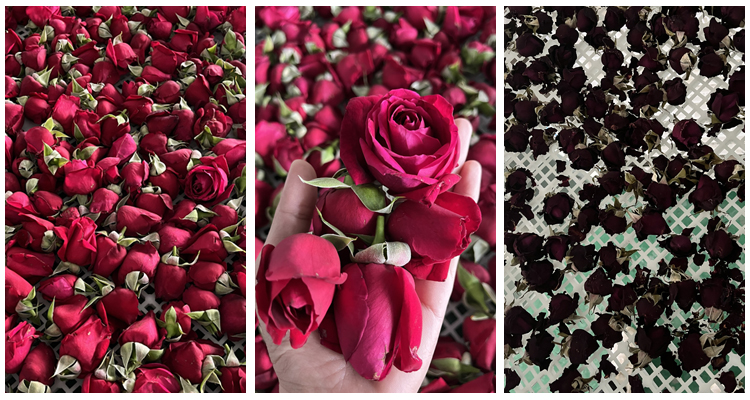
Our heat pump rose petal dryer adopts low-temperature constant temperature drying technology. It evenly removes moisture from rose flowers and petals, well preserving original color, fragrance and active ingredients. Energy-saving and eco-friendly, it features stable running, easy operation and large drying capacity. Ideal for commercial rose flower dehydration, ensuring high-quality finished dried roses with good market value.
🌹 The entire process of drying roses using a tray-cart heat pump
🌿 1. Harvesting and pre-treatment
Harvesting: Select semi-opened buds that have not fully bloomed, as they contain the most concentrated aromatic substances when harvested in the early morning.
Decontamination and grading: Remove leaves, stems, and worm-eaten flowers, and sort them by size and openness before placing them in separate trays.
📥 2. Plate arrangement and loading (the first step to determine uniformity)
Tray selection: It is necessary to use 304 stainless steel mesh trays or punched trays to ensure breathability.
Paving thickness: It is recommended to control it between 5-8 cm, as excessive thickness will hinder the penetration of hot air.
Tray spacing: An air duct space of 8-12 cm needs to be left between trays, which is the lifeblood of cart-type drying.
🛒 3. Cart entry and air duct layoutOnly operate the circulating fan
After pushing the cart into the drying room, don't rush to turn on the machine. First, ensure that the air duct is unobstructed:
Cart spacing: The spacing between adjacent carts should be 15-20 centimeters, and at least 20 centimeters should be left between the cart and the wall of the drying room.
Wind direction check: Confirm that the direction of the cart is consistent with the prevailing wind direction (usually parallel to the airflow direction) to avoid hot air being blocked by the cart frame.
Full and partial loads: If the cart is not fully loaded with trays, use empty trays or baffles to occupy the empty spaces to prevent airflow short-circuiting.
⏳ 4. Segmented drying parameters (core four stages)
Due to the tray-cart type, it is very convenient to rearrange the trays midway, allowing for more precise control over uniformity.
The total time is approximately 12-24 hours.
Stage Temperature Humidity/Dehumidification Time Key Operations
| Setting stage | 35-45℃ | no moisture release | 1-2 hours | The petals expand, maintaining their shape and avoiding curling |
| Main dehydration period | 45-55℃ | The humidity is reduced stepwise from 40% to 30% (active moisture removal) | 8-12 hours | In the middle stage, perform a "tray swap": pull out the cart, swap the upper and lower trays, and swap the positions of the carts. This is the key to uniform drying |
| Dry season | 55-60℃ | The humidity has dropped from 30% to below 15% | 4-6 hours | Ensure that the flower buds and receptacle are completely dried. If any localized dampness is detected, the dish can be emptied again. |
| Equilibrium period | shutdown | Only operate the circulating fan | 1-2 hours | Cool naturally to room temperature in the drying room to eliminate the moisture gradient. |
Operation tips: During the main dehydration period, when pouring the trays, operate quickly to reduce heat loss. If there are signs of scorched edges on the flowers in the
later stages of drying, pull out the cart and quickly flip the buds in the tray to reposition them.
Collecting floral dew: Be sure to collect the condensed water from the drying room, as it is high-value rose cell fluid

 sales@aimheatpump.com
 +0086-18022011556